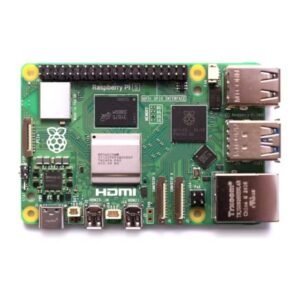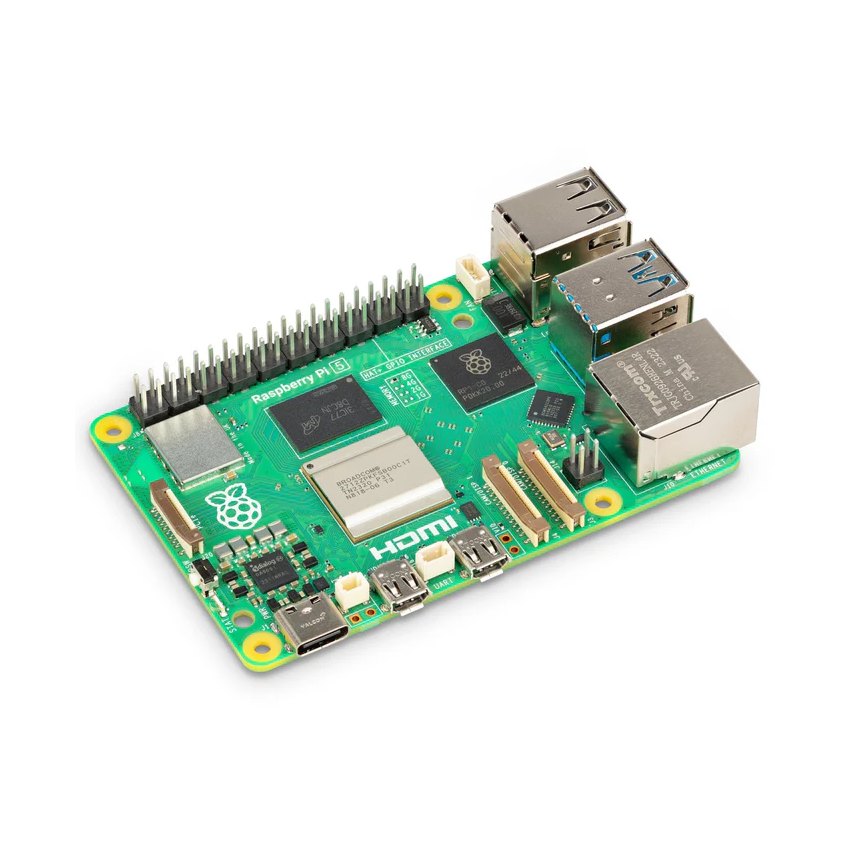
The Raspberry Pi 5 features three newly designed chips, each specifically created to deliver a significant performance boost.
BCM2712
- BCM2712 is a cutting-edge 16-nanometer application processor from Broadcom, evolving from the 28-nanometer BCM2711 processor found in Raspberry Pi 4. It includes multiple architectural improvements.
- Powered by a quad-core 64-bit Arm Cortex-A76 processor clocked at 2.4GHz.
- Features 512KB per-core L2 cache and a 2MB shared L3 cache.
- The Cortex-A76 offers enhanced instructions per clock (IPC) and lower energy consumption per instruction than the Cortex-A72.
- Combining the newer architecture, higher clock speed, and advanced process geometry, Raspberry Pi 5 is significantly faster while using less power.
RP1
- Unlike previous Raspberry Pi models with a monolithic AP architecture, the RP1 provides a more efficient solution by offloading some I/O functions from the main processor.
- Earlier models relied on external devices (e.g., Via Labs VL805 USB controller, Microchip LAN951x USB hub), but this method became technically and economically unsustainable with advancements in process nodes.
DA9091
- The Renesas DA9091 “Gilmour” power-management IC (PMIC) is the third key component, supporting the BCM2712 and RP1 chips.
- Integrates eight separate switch-mode power supplies to manage the required voltages for the Raspberry Pi 5.
- Features a quad-phase core supply, delivering up to 20 amps of current to power the Cortex-A76 cores and other digital logic components in the BCM2712.
Key Features
- Processor: 2.4GHz quad-core 64-bit Arm Cortex-A76 CPU
- GPU: VideoCore VII, supporting OpenGL ES 3.1 and Vulkan 1.2
- Display: Dual 4Kp60 HDMI® output
- Video: 4Kp60 HEVC decoder
- Wireless Connectivity: Dual-band 802.11ac Wi-Fi®, Bluetooth 5.0, and Bluetooth Low Energy (BLE)
- Storage: High-speed microSD card interface with SDR104 mode support
- USB Ports:
- 2 × USB 3.0 ports with simultaneous 5Gbps operation
- 2 × USB 2.0 ports
- Ethernet: Gigabit Ethernet with PoE+ support (separate PoE+ HAT required)
- I/O Interfaces:
- 2 × 4-lane MIPI camera/display transceivers
- PCIe 2.0 x1 interface for high-speed peripherals
- GPIO Header: Raspberry Pi standard 40-pin GPIO header
- Additional Features:
- Real-time clock
- Power button